
EDITORIAL: INDIA'S EXAM SYSTEM DID NOT 'FAIL' — IT FUNCTIONED EXACTLY AS THIS PRESSURE-COOKER ECONOMY WAS DESIGNED TO
"The paper did not leak, only some questions came out," says NTA, bravely redefining both education and the English language
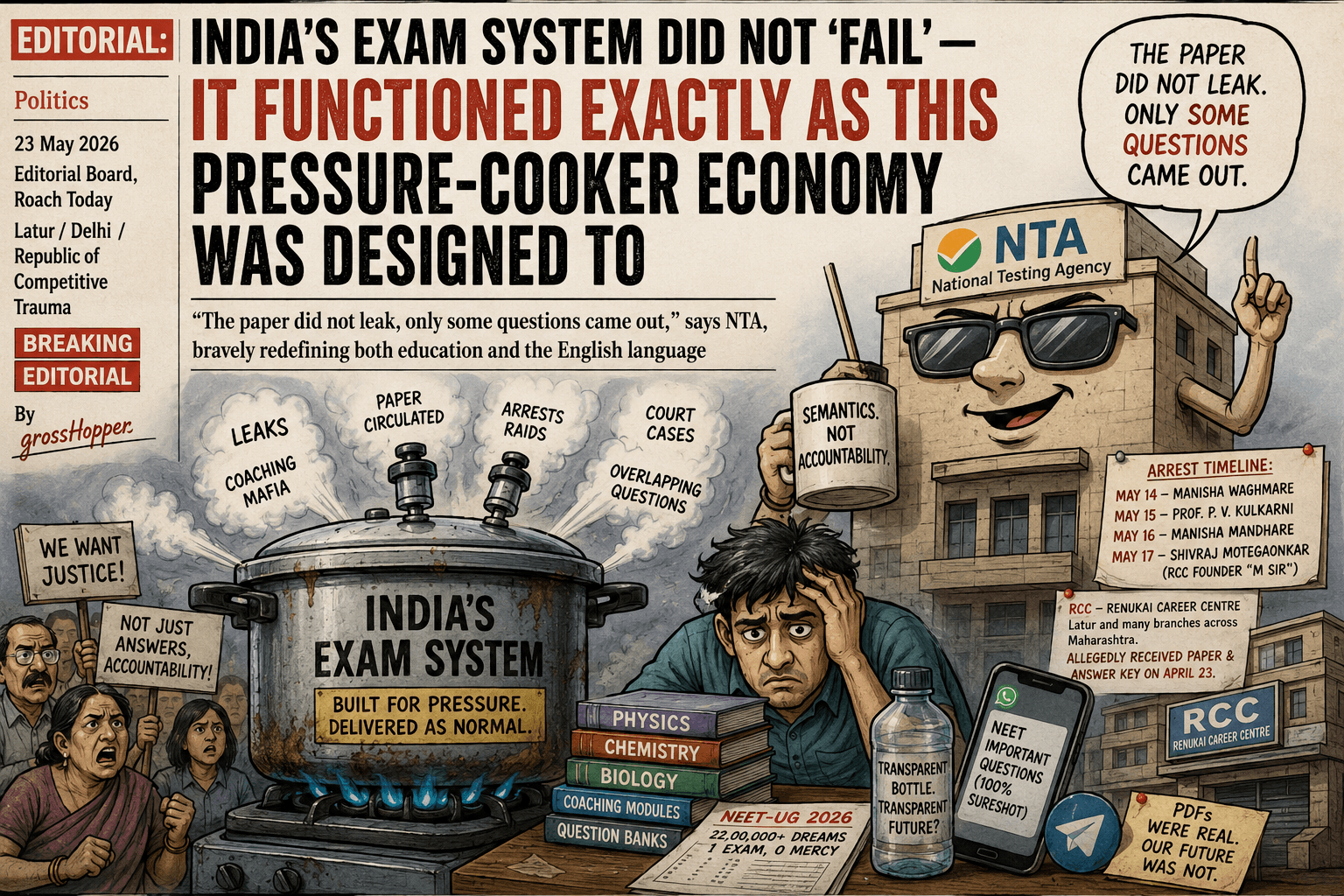
The National Testing Agency has now reportedly clarified that the NEET-UG 2026 paper did not actually "leak." According to the latest official position, only some questions from the paper appeared beforehand through external circulation. Which is honestly one of the greatest pieces of bureaucratic wordplay this country has produced since "temporary inconvenience" was used to describe nationwide chaos.
Because apparently, in modern Indian governance, a paper leak is no longer defined by whether the questions came out before the exam. No, no. That would be too simple. We are now entering a bold new era of educational philosophy where the paper remains spiritually secure even if the contents are allegedly floating around WhatsApp groups like IPL memes.
By this logic, the Titanic did not sink, it merely underwent unscheduled underwater relocation, your wallet was not stolen, only the money inside changed ownership, and a restaurant order is technically correct even if they forgot the food. Absolutely elite crisis management.
The funniest part is that this clarification arrived after weeks of investigations, arrests, raids and court proceedings involving coaching networks, alleged intermediaries and leaked question material. According to investigators, the NEET trail allegedly began in late April when "important question banks" started circulating quietly in Rajasthan and Maharashtra coaching circles. Initially, nobody took it seriously because every Indian student has already received at least fourteen PDFs named _FINAL_REAL_LAST_NEET_100%SURESHOT.pdf during exam season. But by May 1, investigators traced early circulation patterns to Sikar, Rajasthan, where a question bank allegedly containing massive overlaps with the actual paper had spread through WhatsApp groups and coaching channels.
Then came May 3. More than 22 lakh students appeared for NEET-UG 2026 while carrying transparent water bottles, admit cards and the emotional burden of entire bloodlines. Outside centres, parents discussed cut-offs with the intensity of geopolitical analysts debating nuclear treaties. Inside centres, Physics reportedly committed several crimes against humanity. For a few days the exam appeared normal. Then comparisons started.
Between May 6 and May 8, students and coaching groups began noticing alarming overlaps between circulated material and the actual NEET paper. Soon screenshots spread across Telegram and Instagram. The phrase "striking similarities" entered media coverage, which is journalism language for "bro this is looking catastrophically bad." Reports claimed over a hundred questions matched previously circulated material.
By May 8, Rajasthan Police's Special Operations Group formally launched a probe. Searches, detentions and interrogations followed across Rajasthan and neighbouring states. Telegram admins across India suddenly began deleting chats with the survival instincts of raccoons hearing police sirens.
Then the Maharashtra connection exploded.
Investigators began focusing on RCC — Renukai Career Centre — one of Maharashtra's major coaching chains headquartered in Latur with branches across Pune, Nashik, Solapur, Kolhapur, Nanded, Akola and Chhatrapati Sambhajinagar. Authorities alleged that leaked questions were distributed through RCC's coaching network via handwritten notes, chemistry question banks and "special batches."
According to CBI allegations submitted before court, RCC founder Shivraj Raghunath Motegaonkar, popularly known as "M Sir," allegedly received the NEET paper and answer key on April 23, nearly ten days before the exam itself. Investigators reportedly recovered matching chemistry material and even a leaked paper from a mobile phone during searches at RCC-linked properties. But relax everyone. The paper did not leak. Just the questions, the answer key, the mock tests, the handwritten notes, and perhaps the remaining emotional stability of 22 lakh students. Tiny distinction.
The arrest timeline itself now reads like the casting sheet of a very stressed-out crime thriller. On May 14, CBI arrested Manisha Waghmare, accused of mobilising students and linking them to special coaching arrangements. On May 15 came the arrest of retired chemistry professor P. V. Kulkarni, described by investigators as a key source figure and former NTA domain expert — which is objectively horrifying because "domain expert" sounds like exactly the type of person who should not allegedly be leaking a national examination. On May 16, biology lecturer and alleged NTA panelist Manisha Mandhare was arrested from Mathura. Then on May 17, RCC founder Motegaonkar was arrested from Latur and brought to Delhi, where the court granted CBI custody for interrogation into what investigators described as an "organised gang" involved in obtaining and distributing the paper.
India has officially entered the "semantic damage control" phase of institutional scandal management — the stage where nobody denies the suspicious thing happened, but everybody aggressively debates the terminology. First it was "These are just rumours." Then, "There may have been irregularities." Now we have "Some questions matched, but the paper itself did not leak." At this rate, by next week somebody will announce, "Technically the exam maintained confidentiality because the stapler was secure."
The country is now having a full-scale philosophical debate about whether leaked questions count as a leaked paper. Physics aspirants preparing for NEET reportedly called this "the first practical application of quantum uncertainty in Indian education." Schrödinger's NEET Paper: simultaneously leaked and unleaked, compromised and uncompromised, available beforehand yet officially confidential. Nobel Prize material honestly.
And this is precisely why public trust is collapsing. The issue is no longer just the leak itself. The deeper problem is the refusal to speak plainly. Every institution now communicates like an HR department explaining why the office building exploded. Nobody says: "We failed." Instead the public receives beautifully sterilized phrases like: "certain isolated irregularities involving limited question exposure."
Brother. If over a hundred questions allegedly matched circulated material, that is not "limited exposure." That is the educational equivalent of discovering your house has no roof.
Students are not fools. These are people solving organic chemistry while running on four hours of sleep and parental pressure powerful enough to bend spacetime. They can absolutely detect linguistic nonsense. And imagine how absurd this entire situation looks from their perspective. Lakhs of students studied for years, isolated themselves socially, sacrificed hobbies, survived coaching factories, attached their self-worth to one exam, only to watch adults on television argue over the metaphysical definition of the word "leak." Phenomenal nation-building exercise.
The truth nobody wants to admit is that India's entrance-exam ecosystem has become too large, too commercialized and too emotionally loaded to function cleanly anymore. Coaching institutes now operate like multinational corporations. Entire cities survive economically because anxious teenagers keep arriving with backpacks and impossible expectations. Kota became an industry. Sikar became a factory. Latur became a network. And somewhere along the line, education stopped feeling like learning and started feeling like participation in a giant national battle royale where everybody is exhausted and somebody always has early access.
This scandal merely exposed the part that was previously hidden under motivational speeches and AIR banners. The most dangerous consequence is not even the leak itself. It is the slow death of belief. Once students begin feeling that insider access matters more than effort, the entire mythology of meritocracy starts collapsing in real time. And once that trust disappears, no amount of press conferences or terminology adjustments can bring it back.
At press time, coaching institutes across India had already launched "RE-NEET ELITE SUCCESS BATCHES" while exhausted students quietly reopened NCERT textbooks they had emotionally cremated two weeks ago. The exam may or may not have leaked according to official terminology. But public confidence definitely did.
"Perhaps," writes grossHopper, "the most telling detail is not that a paper leaked. It is that the students who were cheated are the ones now preparing to take it again — without complaint, without protest, without a single day to process what happened to them."
— Hop Hop out.